

1. Overviewof the Solution
Tofulfill the client’s need, STEC has designed the dual-fiber CATV solution. Byway of the dual-fiber, the solution provides the client (the hotel) withhigh-quality Ethernet coverage, WiFi coverage and CATV.
2. Descriptionof the Solution
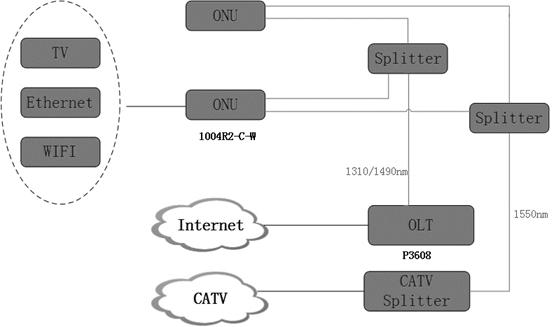
Thesolution introduces four kinds of equipment: STEC P3608 OLTs, 1:32 Splitters,CATV Splitters and STEC 1004R2-C-W ONUs.
a) Deployone P3608OLT in the machine room of the hotel and one CATV splitter. Theeight ports of the P3608 OLT correspond respectively to each floor of the8-storey hotel building. The CATV splitter is used to distribute signals toeach floor.
b) Deployone 1:32 splitter on each floor. The splitter uplinks to the PON port of one P3608OLT and to one CATV splitter.
c) Deployone 1004R2-C-W ONU in each room. The dual-fiber ONU can uplink to the PON portof an OLT and the CATV port. The ONU is also with WiFi function.
d) Deploythe NMS (Network Management System) in the machine room. The whole EPONsystem is in under the unified monitoring and management of NMS.
1. RecommendedProduct List
|
NO. |
Device |
Model |
Quantity |
|
1 |
OLT |
P3608 |
1 |
|
2 |
ONU |
1004R2-C-W |
208 |
|
3 |
Splitter |
1:32 |
8 |
|
4 |
PON module |
|
8 |
|
5 |
NMS |
|
1 |
4. Descriptionof the Recommend Products
STEC P3600 High-DensityRack-Mounted OLTs
Product Overview
STEC P3600 OLT complies with IEEE802.3ah and P.R.Cintercommunication standard, YD/T 1475-2006, supports CTC20/3.0, automaticallydiscovers and works normally with ONUs of different manufacturers.
STEC P3600 OLT supports the symmetric uplink/downlink1.25Gbps PON transmission rate, efficient bandwidth usage and Ethernetservices, helping carriers to provide reliable services to their users.
Its coupling ratio, 1:64, and its support of differenthybrid ONU networks minimize the carrier’s investment.
STEC P3600 OLT, based on the edge-cutting technologies,is strong in functions. A few of its functions such as QoS guarantee, SLA andDBA can be easily listed out.
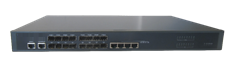
Main Features
STECP3600 Series has following advantages:
EPON
Abidingby IEEE802.3ah, STEC P3600 series meets relevant requirements of EPON OLTregulated in Technical Requirements of "YD/T 1475-2006 and China TelecomEPON Technical Requirements.
System Capacity
P3600Series supports 8, 12 and 16 EPON systems.
Uplink Interface
P3600series with 8 GE uplink interfaces (4 GE optical ports + 4 GE combo ports).
Dimensions
1U,300mm (Depth)
Environmental Protection
Lowpower consumption and low operating cost.
Layer-3 Function
P3600Series supports layer-3 routing function.
Preventing the Bus OpticalFiber:
P3600Series supports that the link can be automatically switched to protect theoptical fiber when trouble occurs in the optical fiber.
Power Characteristics:
P3600Series supports dual-AC, dual-DC and AC/DC power supply. The power supplysupports modularized design, hot-swap and EMC-3 standard. It well adapts to theenvironment.
Technical Parameters
|
Attributes |
P3608 |
|
|
System Capacity |
Maximum coupling ratio, 1:64 128G backplane bandwidth MAC table volume: 32K |
|
|
Ports |
PON |
8 EPON interfaces |
|
Uplink |
8 GE interfaces (4 GE optical interfaces, 4 GE TX/SFP interfaces) |
|
|
The device can be expanded to support two extra 10G interfaces. |
||
|
Attributes of the PON Interface |
A 1Gbps transmission rate with downlink and uplink symmetry Average emitting power of the PON port: +2dbm ~ +7dbm Light reception sensitivity of the PON port: no less than -30dBm Security: ONU authentication mechanism |
|
|
Standard |
IEEE802.3ah IEEE 802.1D, Spanning Tree IEEE 802.1Q, VLAN IEEE 802.1w, RSTP IEEE 802.3ad physical link static/dynamic aggregation (LACP) Ethernet – II |
|
|
QoS |
Backpressure flow control (half duplex) IEEE 802.3x flow control (full duplex) IEEE 802.1p, CoS WR, SP and FIFO Limiting the uplink/downlink rate based on each ONU Supporting DBA and SLA |
|
|
VLAN |
Port-based VLAN Supporting QinQ and flexible QinQ |
|
|
L3 Functions |
Static route, RIPv1/v2, OSPF, etc Routing volume of the host: 8K |
|
|
Multicast |
IGMP IGMP Snooping |
|
|
Reliability |
Unidirectional Link Detection (UDLD) Hot swap of the EPON optical module on the expanded slot Optical path protection of EPON Check of abnormally illuminating ONU |
|
|
Network Security |
Limiting the maximum number of users on each port Port isolation Controlling the storm of packets Flow-based ACL access control function Transmission data encryption on the PON interface |
|
|
Configuration Management |
Various management modes such as CLI, SNMP and TELNET Conducting software upgrade through TFTP and FTP Command prompt in English or in Chinese Debug output |
|
|
Physical Characters |
442.5mm(W) x300mm(D) x 44mm(H) |
|
|
Installation: A 19-inch cabinet |
||
|
Weight: 2kg |
||
|
Environment Requirements |
Working condition: 0℃-55℃; 10%-85% non-condensing |
|
|
Storage condition: -40℃-80℃; 5%-95% non-condensing |
||
|
Power Supply |
Input voltage: AC90~264V, DC -36 ~ -72V Two power inputs, AC-DC-hybrid power inputs and hot swap of power modules are supported. Over-current protection and over-voltage protection are also supported. |
|
STECP1004R2-C Series
Product Overview
STEC P1004R2-C is a smart ONU with 4 100M portsoriented for FTTH in Broadcasting-and-TV industry. It is complied withIEEE802.3ah and relevant requirements for EPON ONU regulated in TechnicalRequirements of YD/T 1475-2006—Ethernet-Based EPON and China Telecom EPONTechnical Requirement 2.1/3.0. STEC P1004R2-C can be well connected with OLTsfrom the mainstream manufacturers.
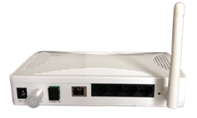
STEC P1004R2-C-W
Main Characteristics
High Access Capacity
It supports the symmetric uplink/downlink 1Gbps PON transmission rate. Connected with STEC OLTs, it can realize 1:64 splitting ratio. The network covering radius can reach to 20km. The transmission distance can expand to 60km if combing the ONU with PON relay.
Secure Service Carrying Ability
For ensuring the secure service carrying ability of ONU, STEC has developed techniques including VLAN, STP, port isolation, ACL, QoS and Broadcast Storm Control.
High Service Control Capability
It supports functions of DBA and Rate-Limit. It supports advanced dynamic bandwidth distribution and accurate bandwidth limit, which enables users to appropriately share 1Gbps bandwidth resource. It also supports QOS function, which guarantees a reliable service quality and service priority.
Rich OAM Functions
It supports standard OAM and expanded OAM defined by Chinese telecom CTC2.1/3.0, including configuration, alarm, performance monitoring, fault isolation and security management, and it also supports private OAM defined by STEC.
Complete Interaction Capacity
It is complied with IEEE802.3ah and relevant requirements for EPON ONU regulated in Technical Requirements of YD/T 1475-2006—Ethernet-Based EPON and China Telecom EPON Technical Requirement 2.1/3.0.
Advanced Energy-saving Technique
It supports the “GreenTouch” architecture and “Smart@CHIP”.
Technical Parameters
|
Attributes |
P1004R2-C-W |
|
User trial interface |
4 fixed 10/100M auto-adaptation RJ45 interfaces, 1 RF, external WiFi antenna |
|
PON interface |
The symmetric uplink/downlink 1Gbps PON transmission rate The network covering radius: 20km Type of the optical interface: SC/UPC Hi-sensible optical receiver: ≤-27dBm Radiation power:0-4dBm |
|
CATV parameters |
Type of the optical interface: SC/APC Wavelength: 1290~1600nm Optical reception power: -18~+2dbm AGC: -9~-2dbm RF out signal level: 82dbuv Operating frequency: 47-1000MHZ |
|
WiFi characteristics |
Support 802.11b/g/n |
|
Dimensions mm (W×D×H) |
163 x 114 x 29 |
|
Environment |
Operating environment: 0℃~50℃; 10%~85% non-condensation |
|
Storage environment: -40℃~80℃; 5%~95% non-condensation |
|
|
Power supply |
DC12V/1A external adaptor power supply |
|
Power consumption |
<10W |
|
Hull |
Plastic |
Software Characteristics
Supports layer-2 switching capacity and meets the requirement of uplink-downlink wire-speed forwarding;
Supports to enable the Layer-2 isolation function by default, and disable it by STEC private OAM;
Supports RSTP required by IEEE 802.1D;
Supports ACL;
Supports IEEE 802.3x flow control (full duplex) protocol;
Supports IEEE 802.1Q protocol, VLAN division based on the user physical ports, VLAN, VLAN tagged/ untagged, VLAN Transmission, VLAN priority tag, VLAN filtration;